SHOT GUIDE · LEMPUYANG, EAST BALI
Gates of Heaven: a mirror, not water
There is no lake under the gate. The reflection is a small mirror held under the lens. Here's how the trick works, how to get it yourself, the real queue and fees, and whether the drive east is worth it.
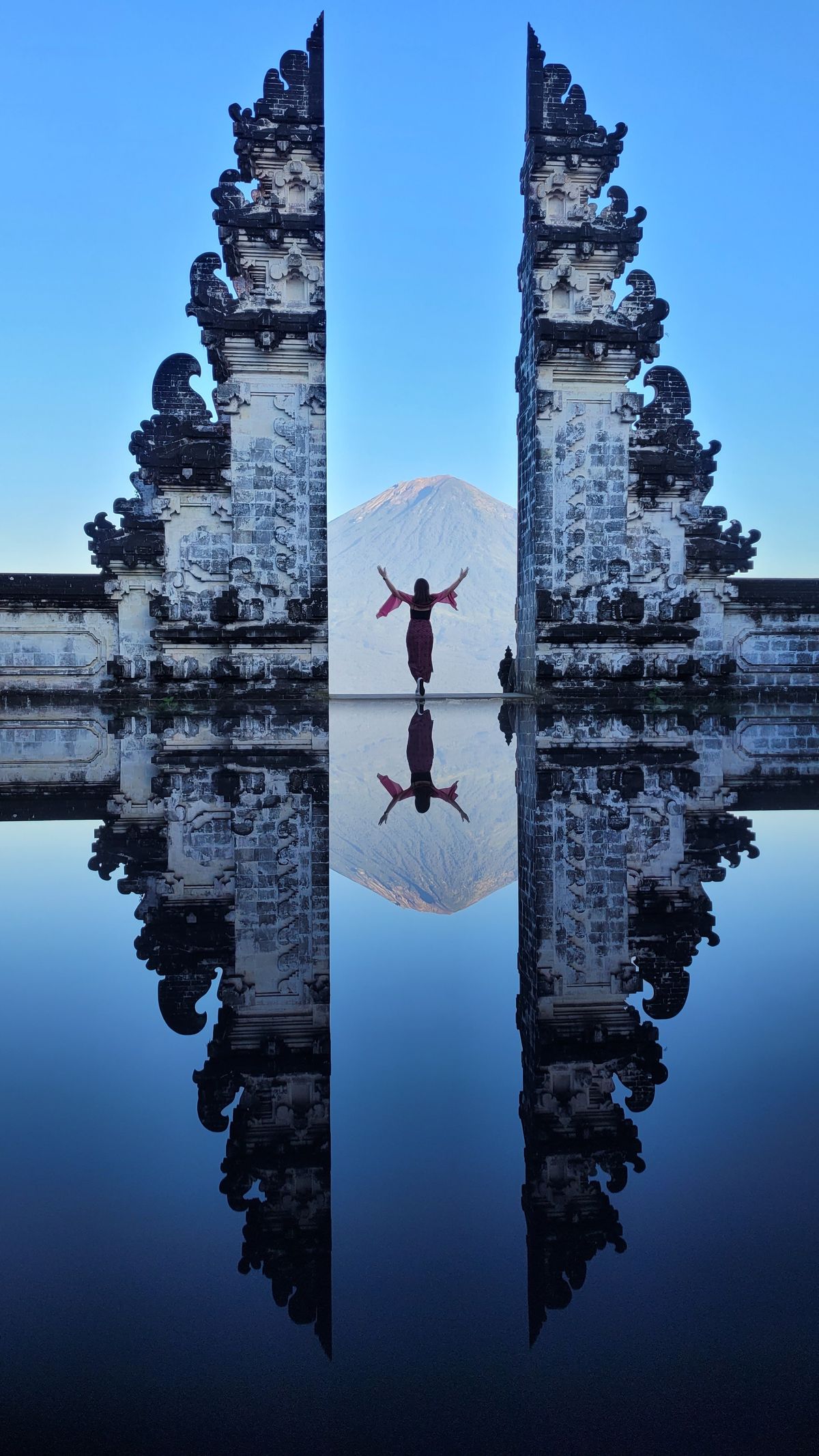
That mirror-smooth reflection under the Gates of Heaven, the one with a person standing between the split gate and Mount Agung doubled below them, is the single most photographed frame in east Bali. Here's the part nobody tells you before the two hour drive: there is no water. The ground is paved concrete. The whole reflection is a small mirror held flat under the camera lens, and once you know that, you can get the exact same shot on your own phone. This guide covers how the trick works, how to do it yourself, the real queue and fees, and whether the day east is worth it.
Is the Gates of Heaven worth it?
Honest answer: it depends on one thing. If you want that one symmetrical frame and you can treat a long queue as part of the day, yes, it's worth going. The gate is genuinely beautiful, and on a clear morning it's one of the best places in Bali to see Mount Agung rising behind you. If crowded photo spots put you off, skip it. One writer who made the trip put it plainly: "if you hate super touristy places and can't stand Instagram hotspots, then the Gate of Heaven is not for you," and added, "I don't think it's worth going out of your way just to see the Gate of Heaven." You'll be waiting hours at an old working temple that has turned into a photo line, and the shot you came for is a two minute mirror trick.
So go for the right reason. Go because you want the frame and you'll make a half day of the drive east. Don't go expecting a quiet temple or a real lake.
The shot: a mirror, not a lake
Here's exactly what's happening. At the main split gate of Pura Penataran Agung Lempuyang, a local photo team holds a small mirror or piece of glass flat, directly below the lens, so the bottom half of the frame reflects the gate and the sky. One photographer guide describes it simply: the person "holds a small mirror or piece of glass directly below the camera lens to create a perfect, mirror-like reflection." A visitor who watched it done said the team "position it halfway across your camera lens to get that epic reflection shot." The ground itself is "paved and there's proper drainage." There is, in the words of a guide checked this month, "no water at the gate at all." There was briefly real water here years ago, but that's long gone.
When your number is called you hand your phone to the photographer, they crouch, hold the mirror, and fire off a burst. It takes under a minute. The shot below is the realistic version: same gate, same mirror reflection, but a white cloudy sky instead of the volcano, which is what most mornings actually look like.
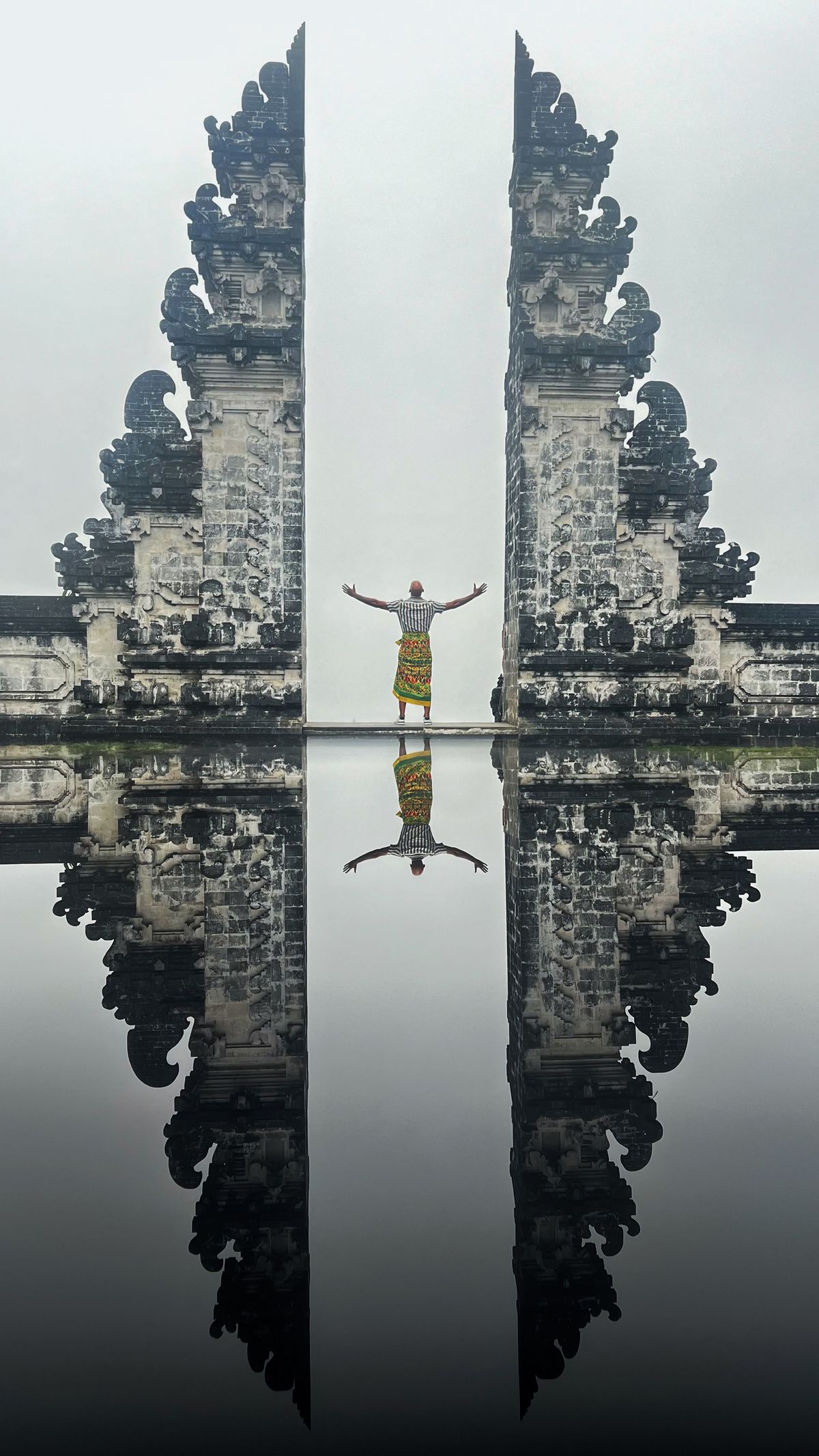
One tip that saves the shot, from a visitor who learned the hard way: "Give them your smartphone, even if you have a fancy camera. The mirror technique didn't work with my camera as the shots came out weirdly bleached with no reflection." A phone's small lens sits flush against the mirror, so the trick is cleaner on a phone than on a big camera. That matters for what gear to bring, which we get to below.
To do the reflection yourself: bring a small mirror, a phone with a glossy screen, or a flat piece of glass. Hold it flat against the bottom edge of your lens so it covers roughly the lower third to half of the frame, then get the camera low, close to the ground. The reflection doubles whatever is above the mirror line, so line up the gate and your subject in the top half and let the mirror do the rest. The lower and wider you shoot, the bigger the fake "pool" looks.
When should you go to beat the queue?
Early. This is the whole game at Lempuyang. A guide checked in October 2026 says that "between about 7 and 11 am a wait of 2 to 4 hours is common." But timing inside that window is everything: one visitor "waited about 30 minutes for our chance between the gates and, when we walked back past later, it was at least 2 hours long." Another puts the floor at "an hour is the minimum wait time." So the plan is simple: be in the first shuttle up the hill at opening, get your number early, and you might be done before the crowds that waited till mid-morning have even parked.
Early also gives you the light and the volcano. A photographer's guide says "early morning is often the best time to visit, as the lighting is softer," and to shoot the reflection you want "a clear day." Mount Agung behind the gate is never a given: one visitor "experienced cloudy, grey skies despite visiting in dry season." Go at sunrise on a clear day for the best odds, and if the volcano is socked in, the reflection shot still works without it.
What does Lempuyang Temple cost, and what are the rules?
Entry is Rp 100.000 per person, cash. The one thing guides disagree on is the shuttle: a couple of 2026 write-ups fold it into that ticket price, but the most recent source, checked in October 2026, lists it separately at Rp 50.000 return for the five to ten minute minibus ride up to the gate. Budget for it either way. A sarong and sash are included; you'll need them on, with shoulders covered, to enter. Older guides list 6am to 7pm hours, but the two newest agree on roughly 7am to 5pm.
| Entry fee | Rp 100.000 per person, cash only 1 |
|---|---|
| Shuttle to the gate | Rp 50.000 per person return, a 5 to 10 minute minibus up the hill 1 |
| Parking | Rp 10.000 a car, Rp 5.000 a scooter 1 |
| The photo queue | 2 to 4 hours is common between about 7 and 11am 1 |
| The Gate photo | Free with your ticket; a tip of Rp 10.000 to 20.000 for the photographer is customary 1 |
| Sarong and sash | Included with the ticket; shoulders covered 1 |
| Opening hours | About 07:00 to 17:00, first shuttle about 05:30 1 |
| From Ubud | 65 to 70 km, a 2.5 to 3 hour drive each way 2 |
| From Amed | About 40 minutes 1 |
Last checked 19 October 2026. Fees in Bali change often and differ between gates, so carry cash and treat these as a guide.
We found no published drone rule for Lempuyang in any guide we checked. That's not the same as permission: it's a crowded, active temple, and plenty of Bali temples ban drones outright, so don't assume. Our Bali drone rules guide has what the Indonesian sources actually say before you pack one.
For the portrait you'll frame
The classic reflection shot is free and happens on your phone, so you don't need to rent anything for it. Where a real camera earns its place is the version you compose yourself and want to print: the whole gate, a clean sky, Mount Agung behind, shot without a queue of strangers in it. A full-frame body at a wide focal length holds the dark gate and the bright sky together, which a phone struggles with on a harsh morning. Just remember the mirror trick is fiddlier on a big lens, so let the gate team use your phone for the classic reflection and use the camera for your own composition from the camera kit.
Starting points, to adjust on the day:
- Shoot wide, around 24mm, to get both gate pillars and the volcano in one frame.
- Expose for the sky. On a bright morning the gate can go a touch dark; lift it back in the edit rather than blowing out the clouds. Shoot RAW.
- Get low for your own mirror shot. The closer the lens is to the ground and the mirror, the more convincing the reflection.
- Go early for an empty frame. By mid-morning there are people in every background. The clean shot is a sunrise shot.
Capture the whole day east, not just the gate
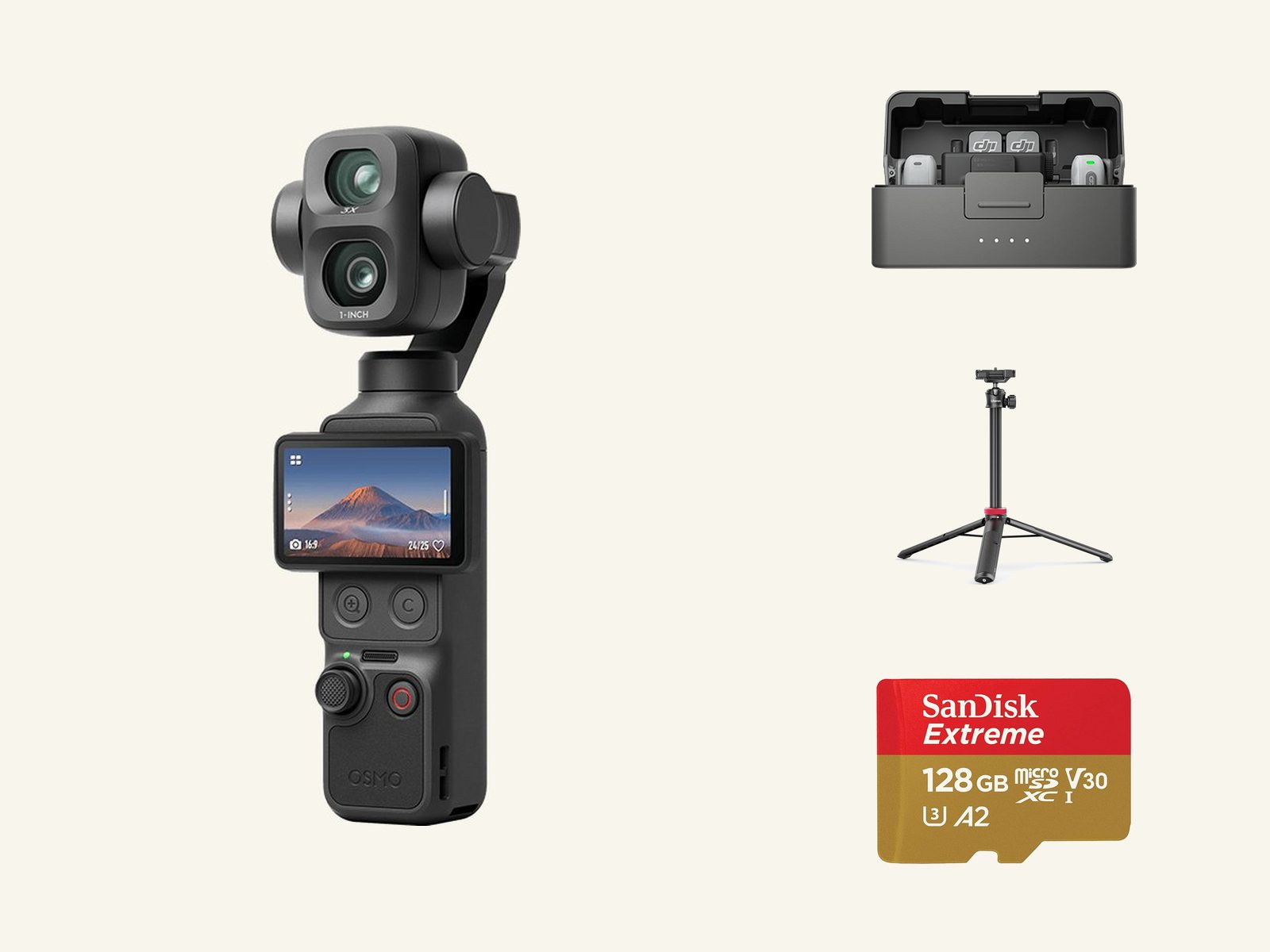
The frame is two minutes. The day is a long drive through east Bali, the hill temple itself, and spots like the Tirta Gangga water palace that most people pair with it. That drive and that wait are the parts you'll actually want on video, and they're hard on a phone you're also trying to keep charged for the gate photo. A pocket gimbal catches the whole day in stabilised clips, and a phone gimbal keeps the reflection video you shoot on your own phone from wobbling.
Both come from the tripod and gimbal line, and both are small enough to forget you're carrying them until you need them.
The visit, start to finish
Leave Ubud before dawn with cash in small notes; it's a 2.5 to 3 hour drive and you want to be first in line. Park, pay, pull on the sarong, and take the shuttle up. Get your number straight away, then wait, this is the two to four hours everyone warns about, so make it before 11am. When your group is called, be quick: hand over your phone, let the team work the mirror, and shoot your own wide composition on the side. Then it's back down the hill and onward to Tirta Gangga before the afternoon heat. You'll do this gate once, and the one frame you waited all morning for is worth setting up properly.
 The Go Bag for this dayThe Everyday Creatorfrom Rp 400.000 a day, delivered to your villaPocket camera, mic and grip in one sling bag for the long day east.See what is inside →
Quick answers
Is there really no water at the Gates of Heaven?
Correct. The ground in front of the gate is paved concrete with drainage. The reflection is a small mirror or piece of glass held flat under the camera lens. There was briefly real water here years ago, but today it's a photo trick, not a pool.
How do I get the reflection photo myself?
Hand the photographer at the gate your phone. The shot is free with your ticket, and a tip of Rp 10.000 to 20.000 is customary. To do it on your own, hold a small mirror flat against the bottom edge of your lens and get the camera low. Phones work better than big cameras for this trick.
How long is the queue for the Gates of Heaven photo?
In 2026 a wait of 2 to 4 hours is common between about 7 and 11am. You get a number on arrival and wait for it to be called. Get there right at opening and some visitors wait only 30 minutes to an hour.
How much does Lempuyang Temple cost?
Entry is Rp 100.000 per person, cash only. The shuttle up to the gate is another Rp 50.000 return, and a sarong is included with the ticket. Parking is Rp 5.000 to 10.000. Bring cash; there are no card machines at the gate.
Will I see Mount Agung behind the gate?
Only on a clear morning. The volcano is often hidden by cloud even in the dry season, so go early and treat a clear Agung as a bonus, not a promise.
Is the Gates of Heaven day trip worth it?
If you want that one symmetrical frame and don't mind queuing, yes. If crowded photo spots put you off, skip it: you'll wait hours at an old temple that has turned into a photo line. It's about 2 to 2.5 hours each way from Ubud.
Sources
- The Bali Guideline: Lempuyang Temple, Gates of Heaven queue and fees (checked October 2026)
- Bali Holiday Secrets: Lempuyang Temple, the Gates of Heaven guide (updated March 2026)
- Jonny Melon: Gates of Heaven Bali (Pura Lempuyang Temple), 2026 guide (February 2026)
- Lizy Travels The World: visiting Lempuyang Temple, tips and what to expect in 2026
- Happiness on the Way: Lempuyang Temple entrance fee, dress code and tips (November 2023)
- Where Goes Rose: Lempuyang Temple and Gates of Heaven, the reality, the mirror and the queue
- Destinationless Travel: is visiting Lempuyang Temple worth it? (updated September 2025)
- Lempuyang Bali: the Gates of Heaven photo trick explained (March 2025)