SHOT GUIDE · UNDERWATER
Underwater filming in Bali
Mantas at Nusa Penida, wrecks at Tulamben and Amed. Which camera gets the shot, how deep it's rated, and when to be in the water.
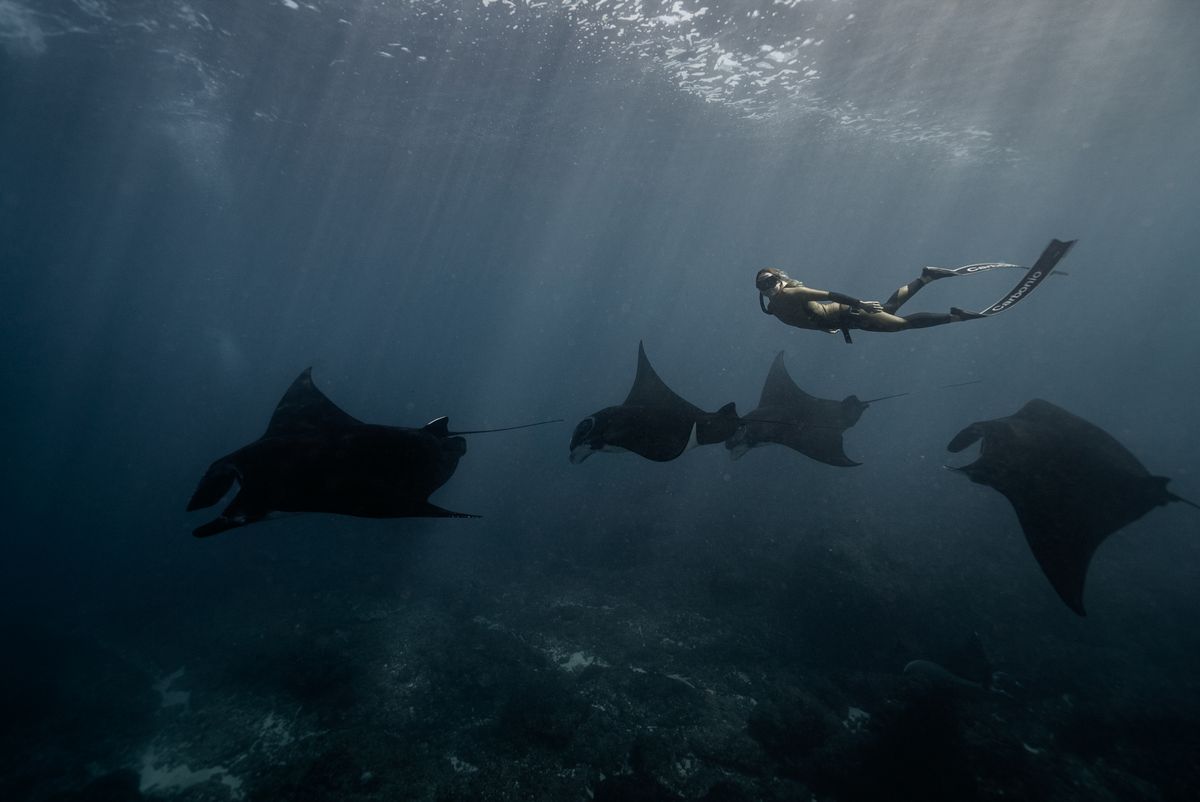
That's a line of manta rays at Nusa Penida, with a snorkeler drifting along below them. You don't have to dive for this shot: the mantas feed near the surface and you watch from above. Most people still come home without it, because the phone they filmed on flooded, or the footage came back a flat dark blue with the mantas lost in it. The fix is a camera that's actually rated for the water and three settings you sort out before you get in. Here's where to film underwater in Bali, which camera gets each shot, and how deep each one is rated.
Is underwater filming in Bali worth it?
Yes, and it's easier than it looks, because the best underwater scenes in Bali sit in water shallow enough to snorkel. Three in particular: manta rays at Nusa Penida, the USAT Liberty wreck at Tulamben, and the Japanese wreck at Amed. None of them needs a dive certificate or an expensive housing to film.
Skip it if you're not comfortable swimming in open water, or if you're set on using your phone. Nusa Penida's manta sites sit on the exposed south side of the island with real currents and swell, and a phone in a cheap pouch is the single thing most likely to flood and end the day. Rent a camera that's rated for the sea and the rest is just technique. If your trip is more rivers and waterfalls than reefs, our Ayung rafting gear guide covers the mounts and dry bags for that instead.
The shot: mantas, wrecks and reef
Three places, three different shots, one shared kit. Here's what each one looks like and where to put yourself for it.
Nusa Penida: swimming with mantas
The shot is a manta gliding toward you with the sun behind it, or a wide frame of you small in the blue with a manta overhead. You reach Manta Bay and Manta Point by speedboat from Sanur, Nusa Lembongan or Toyapakeh. Manta Bay runs around 10 metres deep with the mantas cruising just under the surface, and Manta Point sits between about 8 and 12 metres, so almost everything happens in the top few metres where there's plenty of light. Get low in the water, point the camera slightly up toward the sun, keep at least 3 metres off the manta and let it come to you. A manta that isn't being chased swims slow and close, which is exactly the shot you want.
Tulamben: the USAT Liberty wreck
The shot is the dark hull rising out of the blue with sunrays coming down onto it, and a snorkeler silhouetted above. The Liberty is one of the most reachable wrecks anywhere: it sank about 25 to 30 metres off the beach, so you wade in and swim 20 to 30 metres out, no boat. The wreck runs from roughly 5 metres down to about 30, so snorkellers get the shallow top from the surface on a clear day and divers take the rest. It's a big ship, so shoot wide and let a person into the frame for scale.
Amed: the Japanese wreck and the reef
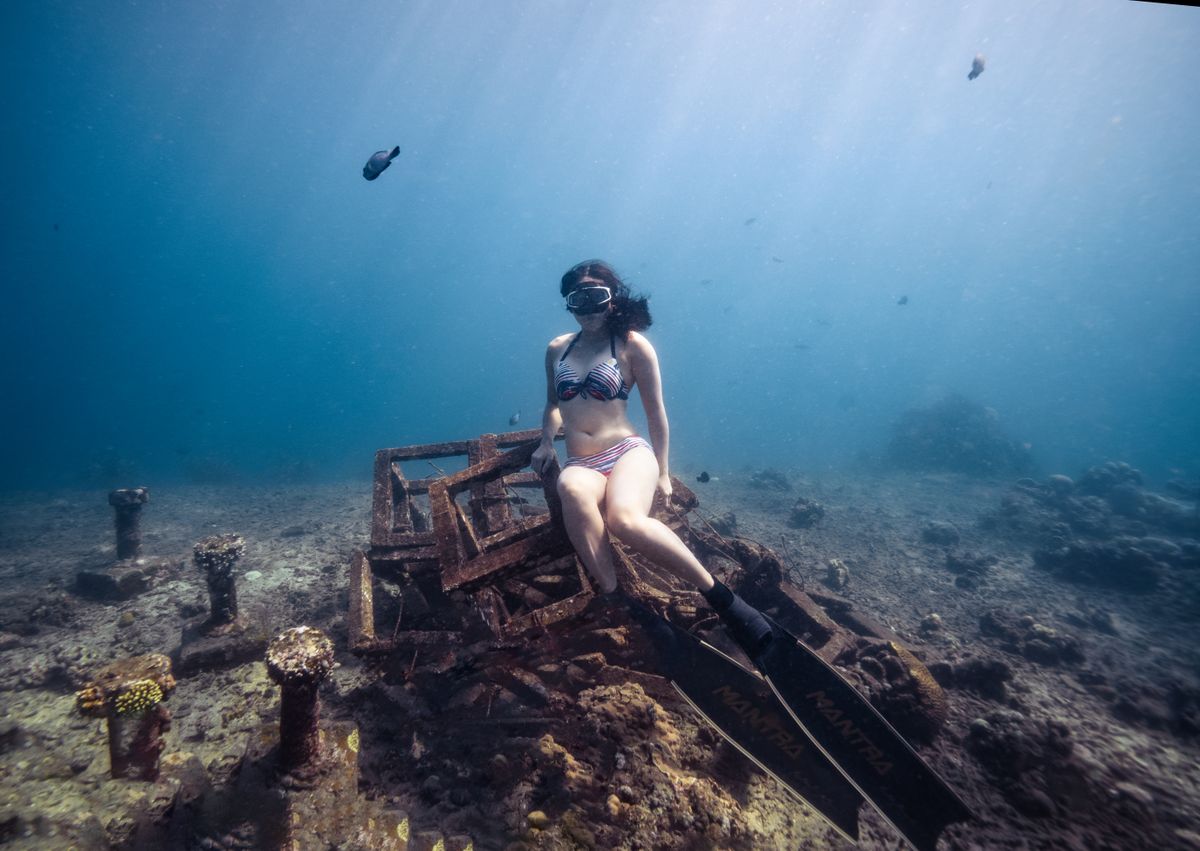
Amed is the shallow, easy one, and the best place to start. The Japanese wreck sits on a seabed about 2 to 20 metres down, with parts of it only 1 to 6 metres under the surface, a few dozen metres off the beach and free to swim to. Coral and reef fish have taken it over, so the shots here are close and colourful rather than big and dramatic. No boat, no current to speak of, and shallow enough that your colours hold without much help.
When should you film underwater in Bali?
Two clocks matter underwater: the sun and the season. For light, aim for the hours around midday, roughly 11am to 2pm, when the sun is highest and its light has the shortest distance to travel through the water, so colours hold and the blue stays bright. For the animals, mantas are at Nusa Penida all year, with the calmest and clearest water about April to October, and mola mola season runs roughly July to November out at Crystal Bay. At the Tulamben wreck the catch is crowds, not light: dive groups build up through the morning, so snorkel early or come back in the late afternoon to have the shallow hull to yourself.
What are the rules, and how deep is each camera rated?
The one rule that's actually enforced underwater in Bali is how you behave around the mantas at Nusa Penida. The rest is depth ratings, so you don't take a camera deeper than it can go.
| DJI Osmo Action 6 | 20m on its own, 60m in the Waterproof Case (IP68) 1 |
|---|---|
| Insta360 X6 | 20m on its own underwater 3 |
| Insta360 Ace Pro 2 | 12m on its own, 60m in the Dive Case 2 |
| Insta360 X5 (previous 360) | 15m on its own 4 |
| 360 dive cases | rated to 60m, and keep the 360 stitch clean 5 |
| Manta rays, Nusa Penida | stay at least 3m back, no chasing, no touching, no flash 12 |
| Manta season | year-round at Nusa Penida, calmest water Apr to Oct 10 |
| Mola mola season | about July to November, Crystal Bay 11 |
| Liberty wreck, Tulamben | 25m off the beach, 3 to 30m deep, beach entry 6 |
| Japanese wreck, Amed | on a 2 to 20m seabed, parts 1 to 6m under the surface, shore access 8 |
| Best light | around 11am to 2pm, sun highest 14 |
| Red filter | useful from about 3 to 24m, pointless near the surface 13 |
Last checked 9 October 2026. Fees in Bali change often and differ between gates, so carry cash and treat these as a guide.
None of these three sites charges a camera fee at the water, and the snorkel spots at Tulamben and Amed are free beach entries. Nusa Penida manta trips are sold as boat tours, so the cost is the tour, not the filming.
The camera that gets the manta shot
For most people the right tool is an action camera. The DJI Osmo Action 6 is waterproof to 20 metres on its own, which covers every snorkel on this page, and the matching dive case takes it to 60 metres with a red filter in the box for when you go deeper. It's small enough to hold in one hand while you swim, and it handles the jump from bright surface to shadowed wreck without fuss. Bring the spare batteries: cool water drains them faster than you'd think, and you don't want to be the one swapping cameras when the mantas show up.
Starting points, to adjust in the water:
- Get close. Water drains colour and contrast over distance, so fill the frame by swimming nearer, not by zooming.
- Shoot slightly upward, toward the sun. It puts light behind the manta or the wreck and keeps the blue clean.
- Sort out colour before it matters. Clip the red filter in or lock white balance once you're below about 3 metres. At the surface, leave the filter off.
- Move slowly, both hands on the camera. Slow is what reads as calm underwater, and it keeps you the polite distance off the mantas.
Capture the whole swim: the 360 camera
If you want the third-person shot, the one where you're small in the frame with a manta passing over you, that's a 360 camera. The Insta360 X6 films everything around you at once on a stick you hold out, and you choose the angle afterwards in the app, so you never have to aim while you're busy swimming. Underwater it needs its invisible dive case, which keeps the 360 stitch clean and is rated to 60 metres. The previous X5 does the same job for less. See the housings on our dive cases page, or the full lineup on the action and 360 camera page.
Your day in the water, start to finish
Pick the site by how you want to swim. Amed if you'd rather walk in off the beach and keep it shallow and calm. Tulamben for the wreck, early, before the dive boats fill the shallows. Nusa Penida for the mantas, on a boat from Sanur or Lembongan, April to October for the clearest water. Charge the batteries the night before, set white balance or clip in the red filter before you get wet, and hold your 3 metres off the mantas. The swim is over in an hour. The footage is the part you keep.
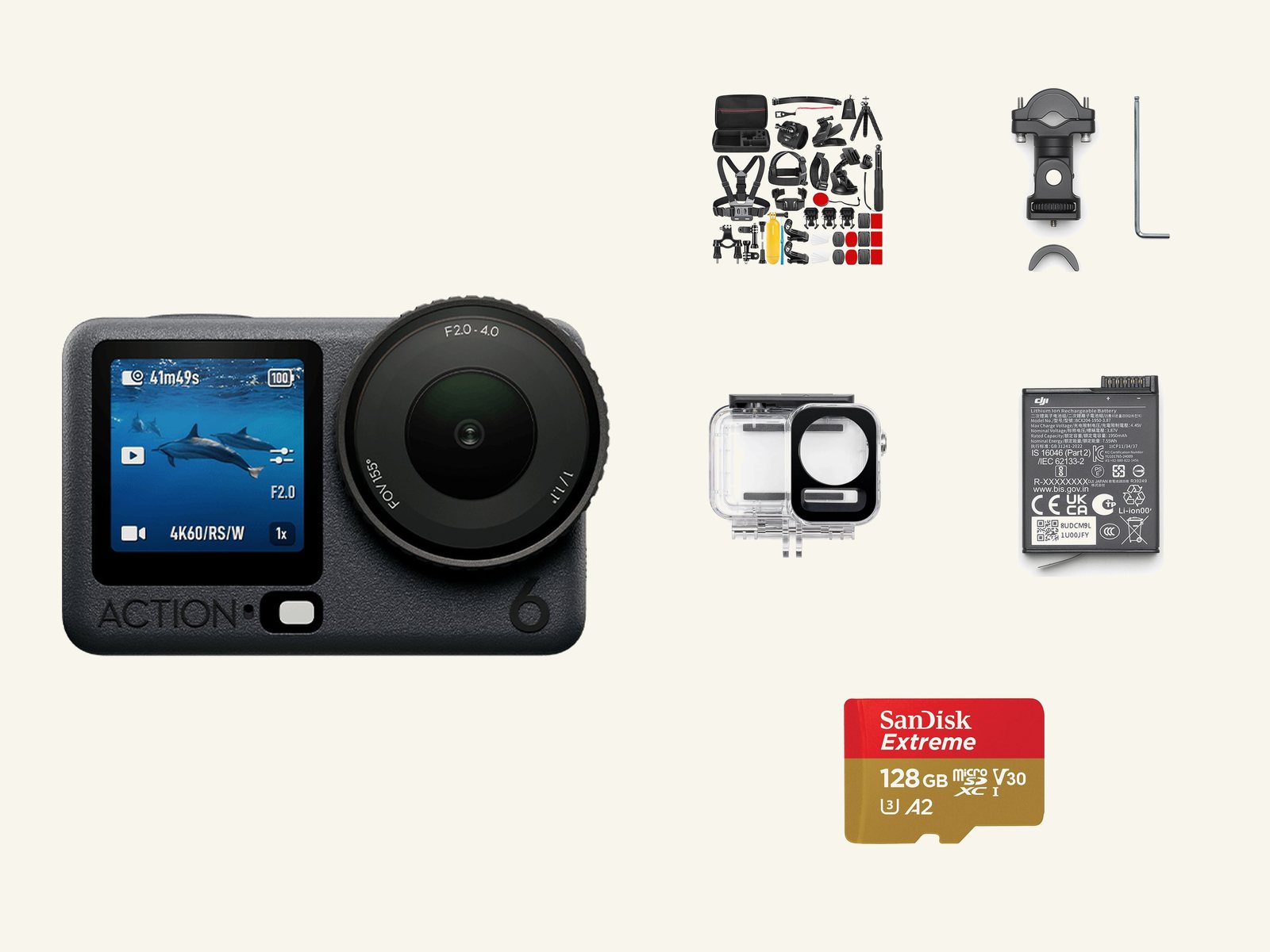 The Go Bag for this dayThe Adventure Creatorfrom Rp 375.000 a day, delivered to your villaAn action camera, a 60m dive case and spare batteries in one hard case, delivered to your villa.See what is inside →
Quick answers
Do I need a dive housing to film underwater in Bali?
Not for snorkelling near the surface. The DJI Osmo Action 6 is waterproof to 20m on its own, the Insta360 X6 to 20m, and the Insta360 Ace Pro 2 to 12m. For diving, add the matching dive case, rated to 60m.
What's the best camera for snorkelling in Bali?
An action camera like the DJI Osmo Action 6 for most people: waterproof, pocket-sized and easy to hold one-handed. For the third-person shot where you swim with a manta in frame, a 360 camera like the Insta360 X6 on a stick, framed in the app afterwards.
Can you see manta rays in Nusa Penida year-round?
Yes. Mantas are reported at Nusa Penida all year, with the calmest, clearest water roughly April to October. Mola mola (ocean sunfish) season runs about July to November.
Do you need a red filter underwater in Bali?
Below about 3m, red light drops away and footage turns blue-green, so a red filter helps from roughly 3 to 24m (our Osmo Action dive case includes one). Near the surface it's pointless, and newer cameras' auto white balance has reduced the need.
How close can you get to a manta ray at Nusa Penida?
The Nusa Penida code of conduct says stay at least 3 metres back, never chase or block a manta's path, don't touch, and avoid flash. Stay still and let it come to you. It makes for a calmer, better shot anyway.
Can snorkellers see the Tulamben Liberty wreck?
Yes. The USAT Liberty sits about 25 to 30m off the beach and from roughly 5m down, so snorkellers can see the shallow top from the surface on a clear day. Divers reach the deeper parts, down to about 30m.
Sources
- DJI Osmo Action 6 official specifications (waterproof ratings)
- Insta360 Ace Pro 2 user manual: waterproofing (12m bare, 60m with Dive Case)
- DIVE Magazine: Insta360 X6 flagship 360 camera (20m without case, 60m with Dive Case Pro)
- Insta360 X5 user manual: waterproof depth (15m)
- Backscatter: Insta360 X6 Invisible Dive Case Pro underwater housing (60m)
- Let's Dive Tulamben: USAT Liberty wreck (25m off shore, 3-30m, beach entry)
- Snorkeling Report: snorkeling the USAT Liberty wreck, Tulamben (crowds, timing)
- Snorkeling Report: snorkeling the Japanese Wreck, Amed (depth, shore access)
- Stingy Nomads: snorkeling at Manta Point and Manta Bay, Nusa Penida (boat, depth, season)
- Nusa Penida diving guide: manta rays (year-round, best season, code of conduct)
- Two Fish Divers: mola mola season Nusa Penida (July to November)
- Freedive Nusa: manta ray code of conduct for freedivers and snorkelers
- Underwater Photography Guide: GoPro underwater video filters (red loss, filter range)
- Ewa-Marine: best time of the day for underwater photography (11am-2pm)